Author Archive

Hike in Council tax funding more police in schools

Posted by editor

Greater Manchester Combined Authority (GMCA) have implemented a hike in Council Tax in order to fund the introduction of police in schools. This is against the wishes of teachers, parents and students  – find out more including how to join the campaign against police in schools.

A hike in Council Tax rates in Greater Manchester will provide £10mil more funding to Greater Manchester Police (GMP). This is on top of the extra £30mil GMP have received from GMCA’s core grant. 

The Council Tax increase (£10mil) will be used to recruit 325 new officers and introduce new policing initiatives, including more police in schools. Our Decriminalise the Classroom report documents the concerns of young people, teachers, parents, and community members around police in schools.

Only 502 people were consulted by GMCA on these plans. Only 34% said they’d support an increase of £1.25 p/m in Council Tax. GMCA went ahead regardless. Not only that, Band D properties will pay £10 more Council Tax!

GMP has shown it’s not only incapable of keeping our communities safe, but that it causes systemic harm and injustice, felt particularly by Black and Brown and/or working-class people. What could the £10mil Council Tax hike fund instead?

Instead of funding new officers, the Council Tax increase could fund 454 School-Based Counsellors (on the average salary of £22,000). Evidence shows this intervention can improve: young people’s mental health & wellbeing; improves behaviour; reduces school exclusions; and improves overall attainment and enjoyment of school.

Instead of funding new officers, the Council Tax increase could fund 454 Youth Workers (on the average salary of £22,000). Evidence shows this intervention helps young people improve and develop positive social relationships; builds their confidence; improves decision making skills; and gives them an outlet to express themselves.

Instead of funding new officers, the Council Tax increase could fund 400 Restorative Justice practitioners (on the average salary of £25,000). Evidence shows this intervention: fosters meaningful dialogue; reducing reoffending; helps to repair harm; and builds a stronger sense of community.

In a context where the police are failing to keep us safe, defunding is an urgent task. Instead, funding must be diverted to community-based programmes for public safety. We must build new ways of responding to harm and inequality, and enacting new forms of justice.
New report on police harassment on Manchester University campus

Posted by editor

The Cops off Campus campaign at the University of Manchester have published a new report, with a foreword from Netpol.

The report highlights a range of issues regarding the presence of police on campus, and amplifies calls for educational spaces to be free from police.

The evidence compiles details of unlawful police searches of student accommodation, police unlawfully demanding personal details from students, the racial profiling of Black students by police and security, and campus police patrols having a negative impact upon student mental health.

The report can be accessed via the Netpol website here.

New Resistance Lab report and upcoming event on Taser

Posted by editor

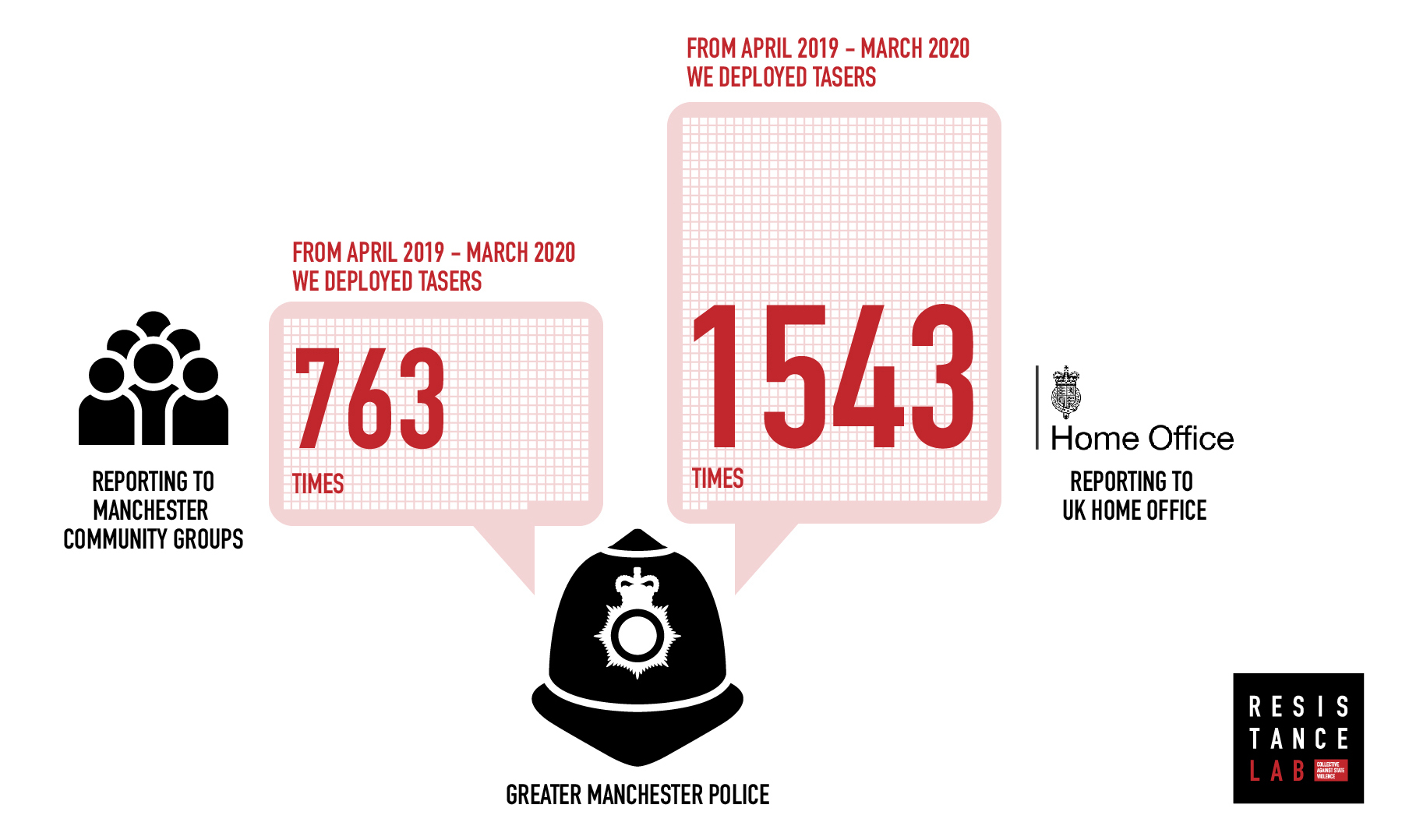
A new Resistance Lab report finds that Taser usage by GMP has risen to its highest ever level, with Black people now five times more likely to be subject to a Taser related incident than their white counterparts.

There are also discrepancies in GMP’s reporting of their Taser use meaning that the force have been under-reporting figures in their infographics and in their interactions with community groups. This compounds ‘serious concerns about GMP’s transparency and honesty with the community they claim to serve’.

Infographic showing reporting taser deployments to community groups: 763 times vs to UK Home Office: 1543 times

The 2021 report, which can be read here, builds upon Resistance Lab’s first report, ‘A Growing Threat to Life: Taser Usage by Greater Manchester Police‘, published in 2020. The latest report adds to the raft of evidence detailing the harms caused by GMP, and reiterates our shared call for the abolition of Taser.

On 18th March, from 17:00 – 18:30, Resistance Lab will be hosting a live ‘No More Tasers’ panel event, chaired by Patrick Williams, with Mike Shiner, Stafford Scott, Jessica Pandian, Kerry Pimblott and Kim Foale as panellists. For more information on the event see here.

Joint Public Statement: NGOs Condemn Appointment of William Shawcross and Announce Civil Society-led Review of Prevent

Posted by editor

We, the undersigned civil society organisations, express grave concern at the UK government’s appointment of William Shawcross as the new reviewer of the counter-terrorism strategy Prevent. Shawcross has been appointed to replace Lord Carlile, who was removed from the post following a legal challenge last year. The appointments of both Shawcross and Lord Carlile have made clear, beyond doubt, that the UK government has no interest in conducting an objective and impartial review of the strategy, nor in engaging meaningfully with communities affected by it. Instead, it is apparent that the government intends to use this review to whitewash the strategy and give it a clean bill of health, without interrogating, in good faith, its impacts on human rights and fundamental freedoms. Without these perspectives, it is impossible to impartially assess the Prevent policy.

We, the undersigned groups, cannot be complicit in a process that serves only to rubber stamp a fundamentally flawed strategy. We therefore announce a collective boycott of the Prevent review. In lieu of participating in the government’s review, civil society groups will conduct a parallel review that properly considers the harms of Prevent, including documenting discrimination and rights violations caused by it.

We, and other non-governmental organisations, have long raised concerns about the discriminatory and anti-Muslim impact of Prevent and its potential to violate core human rights. Many of us were eager to provide evidence to a properly independent review, and to engage with the appointed reviewer. However, Shawcross’s appointment, given his well-known record and previous statements on Islam, and following the debacle of the Carlile appointment, brings into question the good faith of the government in establishing the review and fundamentally undermines its credibility. As a director of the Henry Jackson Society, Shawcross expressed patently Islamophobic views, saying: “Europe and Islam is one of the greatest, most terrifying problems of our future. I think all European countries have vastly, very quickly growing Islamic populations.” As far as we are aware, he has never publicly disavowed these comments. During the period when the Charity Commission was chaired by Shawcross, it was accused of disproportionately focusing on Muslim charities, including by putting them under investigation.

The UK government must fundamentally reconsider its flawed and counter-productive counter-terrorism strategy, which has profound and far-reaching human rights impacts. We condemn its lack of political will to carry out this crucial task—the price of which continues to be disproportionately paid by Muslims across the UK.

Amnesty International

ARTICLE 19

Big Brother Watch

C.A.R.E. – Coalition of Anti-Racist Educators

CAGE 

Child Rights International Network (CRIN)

DefendDigitalMe

Inclusive Mosque Group

Liberty

Maslaha

Medact

MEND

Network for Police Monitoring (Netpol)

No More Exclusions

Northern Police Monitoring Project

Open Society Justice Initiative

The Runnymede Trust

Statement on GMP raid of student accommodation

Posted by editor

10-02-2021

With Greater Manchester Police having repeatedly disgraced themselves recently, last weekend’s police raid of university accommodation is the latest example of heavy-handed policing, with students targeted once again. 

It is apparent that the University of Manchester is playing an active role in subjecting its students to over-the-top policing and heavy fines. Whilst the police do not have power of entry without a warrant or reasonable suspicion that a person is infectious, student accommodation contracts allow the University to authorise police patrols and surveillance of student accommodation. The events of last weekend indicate that University leaders have elected to do just that, subjecting their students to levels of police harassment that they should – in theory at least – be protected from. 

Coming off the back of the university’s reckless and economically driven decision to push ahead with a full return to campus in September, it is yet another demonstration of the University of Manchester’s gross mistreatment of its students. This mistreatment has also included the heavy securitisation of campus which led to students being locked up in their halls, the erection of restrictive fences, ID checks, the racial profiling of a Black student by campus security, and the disproportionate use of police power in response to student demonstrations. Even in this context, and despite some success for the student rent strikes, the university continues to extort expensive halls (and tuition) fees from students. It is clear that the university has learnt nothing from its recent failures, some of which we had previously detailed here.  

We extend our solidarity to the students affected and to the student-led cops off campus and rent strikes campaigns. We remain deeply concerned about the encroachment of police and private security on university campuses, and committed to the building of safer educational environments free from police. We look forward to future organising alongside students.

STATEMENT ON THE DOUBLING OF GMP TASER TRAINED OFFICERS

Posted by editor

4 FEBRUARY 2021

Following a recent report in the Telegraph, The Northern Police Monitoring Project condemns Greater Manchester Police’s (GMP) intention to double the number of Taser-trained officers drawing on ring-fenced funding from the Home Office.  This decision demonstrates a reckless disregard for well-documented concerns about the inherent risks associated with police use of Taser raised by human rights and medical experts as well as the individuals and families directly impacted. A recent report by Greater Manchester-based think tank Resistance Lab (2020) showed that between April 2017 and March 2019, GMP oversaw a 73% increase in Taser usage with disproportionate impacts on Black people and other vulnerable communities. In 2018/19, Black people in Greater Manchester were subject to Taser at nearly 4 times the rate of their white counterparts. The report also revealed that Taser was being routinely used against children and vulnerable adults, particularly those with mental health issues. These concerns have increasingly attracted the attention of the Independent Office for Police Conduct (IOPC) which intervened in two such cases in 2020 alone. In May, the IOPC opened an investigation into GMP’s use of the weapon against Desmond Ziggy Mombeyara in front of his infant child in Stretford. In December, the ‘independent’ watchdog also called on GMP to reinvestigate the 2014 case of Michael Gilchrist, an autistic man who was left traumatised after police repeatedly used Taser to subdue him during a mental health crisis. Despite these growing concerns, GMP – a force currently under ‘special measures’ and whose culture and practices are coming under increased scrutiny including from GM Mayor Andy Burnham – is moving forward with blinkered plans to rollout Taser to 1,100 officers. Such a strategy will only result in greater unnecessary losses of life and serious injury with disproportionate impacts upon our most overpoliced and vulnerable communities. 

Justice for Mohamud

Posted by editor


We are deeply concerned by the tragic case of 24 year old Mohamud Mohammed Hassan, who was violently arrested at his home in Cardiff on Friday by South Wales police, and released without charge the following day. Later that evening he was found in his bed unresponsive, family members report that his body had sustained severe injuries while being held in custody at Cardiff Bay police station. 


While the circumstances of his death are being investigated, NPMP are saddened to learn of yet another death following police contact. According to Inquest, there have been at least 1684 deaths in (or after) police custody since 1990. The figures are now, according to the Independent Office for Police Conduct, at their highest levels for a decade. A disproportionate number of those killed are from a black or minority ethnic background. 

As we await further details of this case, we will continue our work with local communities and seek justice for those impacted by police brutality and racism.


We fully support Mohamud’s family justice campaign to which you can donate here: 
https://www.gofundme.com/f/help-and-serve-justice-for-mohamud-hassan

We send our love and solidarity to Mohamud’s family and friends. No justice, no peace.

Policing Migrants: Biotechnology as Border Agents

Posted by editor

This article was initially published in the NPMP Magazine Issue 2. You can read all the articles and the full magazine here. To order your physical copy please email npolicemonitor@gmail.com.

by Laura Loyola-Hernández (Stop the Scandal) 

Over the past couple of weeks, an unprecedented number of protests have erupted in the UK in support of Black Lives Matter following the murder of George Floyd in the Unites States. On June 27th, on the one year anniversary of Shukri Abdi’s death, a Black Muslim refugee girl, a protest was organised in her name. Hundreds of people chanting “No Justice, No Peace” and “Justice for Shukri” inundated the streets. Shukri’s tragic death signals wider issues around systemic failures by schools, the police and the UK government’s treatment of migrants, in particular Black people with precarious immigration status.

The hostile environment, a set of government policies first implemented by then Home Secretary Theresa May, has been in place since 2012 to make life so difficult in the UK that migrants would want to voluntarily leave the country. Banks, schools, landlords, doctors, nurses and universities all became border agents. The hostile environment has leaned heavily on the use of technology as a surveillance mechanism and the police as an active operating arm of it. A pilot program to use a biometric fingerprint scanning device and app connected to the Home Office immigration database by police was launched in West Yorkshire in February 2018 (now used nationwide): anyone suspected of committing a crime and lying about their identity can be stopped in the street, have their fingerprint scanned by police on the spot, and have their details searched in both the Police and Immigration databases. Given that anyone with an immigrant status (someone on a visa, with Indefinite Leave to Remain, asylum seekers, refugees or precarious migrant status) will have their fingerprints stored in the Home Office immigration database, a potential traffic stop could end with someone being detained by Immigration Enforcement, maybe unlawfully due to an unreliable Home Office database.  From our #STOPtheSCANdal campaign’s Freedom of Information request, we know that Black and Brown communities are disproportionately targeted by these searches. Liberty has warned that these technologies can deter survivors of domestic abuse in coming forward as their immigration data can be shared with the Home Office. This is particularly concerning given the astronomical increase in the number of domestic abuse cases since the COVID-19 lockdown. This is not the only consequence that COVID-19 has had on migrant communities in the UK.

The police use of Motorola’s PRONTO software (Police Reporting and Notebook Organiser, PRONTO), which includes the biometric fingerprint app, has been updated with COVID-19 penalty functions introduced among the new emergency police powers granted by the Coronavirus Bill in March. This new development will compound the unequal impact of the pandemic with the discrimination and lack of accountability embedded in policing technologies. Big Brother Watch’s research, which examined fines given in England under the Coronavirus Bill, found that Asian people received at least 13% of penalty fines even though they represent 7.8% of the national population, and Black people were issued 5% of fines despite being 3.5% of England’s population. 

The impact of COVID-19 has already been devastating on Black, Brown and migrant communities. The COVID-19 report released by Public Health England in June demonstrates that, in comparison to white people, ‘BME’ people (to use the report’s terminology) are more likely to die from the virus. Black people specifically are 4 times more likely to do so than the average for all ethnic groups. This percentage increases for people born outside of England. The report found that, in comparison to the all group average), people from Central and West Africa are 4.5 times more likely to die of COVID-19 while in this country. A joint report by migrant organisations and campaigns found that the hostile environment is having a devastating impact on migrants’ access to healthcare during the COVID-19 crisis. The report concluded that 57% of respondents were actively avoiding seeking medical advice because of fear of being charged, their data being shared with the Home Office, and other immigration enforcement issues. Those with precarious migrant status, often in frontline jobs, have No Recourse to Public Funds (NRPF) which means they are unable to access universal credit. Migrants are being forced to work despite having COVID-19 symptoms out of fear of becoming destitute or being threatened at work. During a pandemic we are only as safe as the most vulnerable in our society. Nobody should be forced to put their life at risk during a pandemic out of fear of immigration enforcement, and the police should not be working to make it harder for migrants to stay safe. These fears will only increase under the use of Schedule 21 of the Coronavirus Act, where police and immigration officers are now given the power to stop and hold anyone suspected of having the virus for 3 to 48 hours.

Many who took to the streets on June 27th in the name of Shukri Abdi put their own immigration status in jeopardy by breaking lockdown rules. It is important to remember migrants do not have the same rights when stopped by police. But until there is no more need to protest social inequalities in the streets we will continue to scream and give voice for those that can no longer chant:

No Justice, No Peace.    Justice for Shukri.   Abolish Hostile Environment.   Defund the Police.

This article was initially published in the NPMP Magazine Issue 2. You can read all the articles and the full magazine here. To order your physical copy please email npolicemonitor@gmail.com.

‘Firearms raids – what about the children?’

Posted by editor

This article was initially published in the NPMP Magazine Issue 2. You can read all the articles and the full magazine here. To order your physical copy please email npolicemonitor@gmail.com.

by Anonymous

Ever since being subjected to an armed police raid on my home, my thoughts kept going back to a single question: where is the duty of care for young people in these situations?  Has there not been any prior investigation of minors in the home?  Why isn’t there an appropriate adult on the scene to ensure that the mental health of that innocent young person isn’t permanently damaged?

At approximately 2 am in the morning I was awoken by shouting, banging, and a torch light being shone through my upstairs bedroom window.  I initially thought I was dreaming, but on realising this was real and hearing shouts of “armed police,” I ran down the stairs and opened the door to a gun being aimed at my forehead.  I was ordered to step outside slowly with my hands in front of me, only wearing pyjamas with no shoes or socks on a freezing winter night.

There was lots of shouting and aggression, “Is anyone else in the house?”  Thankfully neither my son who they had come for, nor my youngest child were present.  “We’re sending the dog in so you need to tell us, or they will be attacked by the dog”.  I repeated that no one else was there and was led down the path, and about two houses away, still with a gun pointed at my head, I was told to put my hands on the wall.  I started shaking with a combination of fear and cold.  I looked around and the road had been blocked off by police cars at each end; innocent pedestrians and motorists were being screamed at to go the other way.

It’s funny the random things you think of in a situation like this: I wondered why someone was out walking their dog at this time of the morning, she looked petrified being screamed at in such an aggressive way.  Then I began to think of things I was grateful for, at least neither of my children were at home, and at least it was a Friday, so I didn’t have to get up for work in the morning.  I think I was able to remain so calm because I only had to deal with my own emotions.  I know it would have played out very differently if I had to consider the trauma of my children, especially my 10-year-old.  There is no way I would have walked away from my house and allowed my youngest child to be woken up to a gun in their face and all the shouting. What would have happened in that scenario?  I felt I had a lot to be grateful for in that moment.  I eventually asked the officer if I could cross my arms as I was really shaking by this point and felt very exposed.  He looked me up and down and said, “yes you don’t look like you’ve got anything on you.”  Another officer eventually brought me some shoes that were on the stairs.  

After they had been around the house with the dog, they let me back in.  Two plain clothes Xcalibre Officers came in, a male and female.  I asked whether I could use the toilet, she laughed and said, “yes, but don’t be pulling any guns out.”  I didn’t even honour that comment with a response. I was told I needed to leave my home as it was now a crime scene, and no one was available to do a search until between 7 am and 9 am the next morning.  Fortunately, my friend answered the phone when I rang – by this time it must have been close to 3 am.  The officer waited outside my bedroom door while I got dressed and then I had to leave.  I felt humiliated and thought about how unnecessarily loud they were; my whole street must have been awake.  My next-door neighbour told me the following day that there were twenty-two armed officers. She had counted them through the window, even though they had also screamed at her and her daughter to move back.  Clearly, they thought my son was going to come out shooting everyone in sight, even though he has never been convicted of a firearms offence in the past.

Since this traumatic event, I refer back to my original questions, what guidelines do armed police have for minors in the home?  Why is no one there to put the needs of children at the forefront of all of this?  As an adult now, I feel a lot of anxiety: I always leave my key in the door now in case I ever need to open it quickly again.  What impact would this have had on my child? What impact has it already had on the many young people who must have been subjected to this inhumane treatment? When will these questions be answered?

This article was initially published in the NPMP Magazine Issue 2. You can read all the articles and the full magazine here. To order your physical copy please email npolicemonitor@gmail.com.

No Police in Our Schools

Posted by editor

This article was initially published in the NPMP Magazine Issue 2. You can read all the articles and the full magazine here. To order your physical copy please email npolicemonitor@gmail.com.

by Remi Joseph-Salisbury (NPMP)

There should be no doubt that Boris Johnson’s election victory was a monumental blow for the anti-racist left. As state-driven racisms deepen, we need to pay attention to the challenges facing communities of colour. The Tories vowed to be the party of ‘law and order’, and we should expect increasingly authoritarian and punitive forms of social control – including ramping up the presence of police in UK schools.

The past few years have seen calls to significantly increase the number of police officers working in schools. Among the high-profile advocates are the children’s commissioner, the head of the Metropolitan Police and a Home Affairs Select Committee on serious youth violence. While there appears to be relative (and rare) political consensus on the ‘merits’ of this intervention, these plans should really be a cause for concern.

Rather than making schools safer, a police presence risks irreparable damage to our learning environments. In my research on racism in schools, secondary school teachers expressed serious concerns about the detrimental impact. Teachers described the efforts they go to in making their schools a comfortable and safe space for their students.

As one teacher from a racially diverse school in Greater Manchester explained, even though students might ‘see school as crap at the time, they see it as a safe space’. The presence of police in schools, he warned, risks disrupting this sense of safety. Particularly for students from already over-policed communities, schools-based police officers threaten to turn schools into an environment of fear, suspicion and alienation.

We know that black and Asian young people are more likely to be subject to policing practices such as stop and search. They are also more likely to be subject to school disciplinary procedures, including exclusions. It is not a leap, therefore, to suggest that students of colour are more likely to be subject to police attention in schools. Evidence from the US certainly suggests this is the case. As the American Civil Liberties Union has warned, a police presence risks turning minor incidents into criminal issues, with potentially devastating consequences.

Perhaps most troubling are the ties between schools-based police officers and the prison-industrial complex – the ever-expanding network of profiteering that governs the expansion and privatisation of prisons. The presence of police in schools facilitates the early filtering of young people towards prison.

US activists have drawn attention to this issue, with the National Association for the Advancement of Colored People warning in 2005 that ‘the punitive and overzealous tools and approaches of the modern criminal justice system have seeped into our schools, serving to remove children from mainstream educational environments and funnel them onto a one-way path toward prison’.This warning should resonate here. Not only does the UK incarcerate an even higher proportion of its black population than the US, according to a 2017 review by David Lammy for the justice ministry, but it also has the second-highest proportion of its prisoners in private prisons (after Australia), at 20 per cent.

With the government committed to increasing police powers, expanding prisons and placing more police in schools, we need to pay urgent attention to the pipeline feeding young people of colour into the expanding prison system.

The long histories of institutional racism in both policing and schooling indicate that schools-based police officers are likely to intensify the racisms facing students of colour.

It is important that we oppose these plans and call for our schools to be free from the presence of police officers.

This article was originally published in Red Pepper Magazine