Archive for the ‘Uncategorized’ Category

Information for protesters

Posted by admin

A thread for Manchester protesters. We’ll be available via Twitter & email all weekend: npolicemonitor@gmail.com. Reach out, if you need us. Go prepared – mask, hand sanitiser, water, food, charged phone. Wear nondescript clothing. The police will use facial recognition tech.

Try to maintain social distancing. Police may try to contain protesters, pushing you together. Try to keep 2m space, if possible. The police may “kettle” (contain) protesters. They can keep you there as long as they deem ‘necessary’. The best thing you can do is stay calm.

Write these numbers on your ARM in case you are arrested, and your phone is off or lost.

Manchester Green & Black Cross 07761911121

Hannah @ Burton Copeland 07768805384

Avoid filming and taking photos. Blur faces if you do. The police can use the footage against you and other activists.

Consider knocking off your phones. The police may use it for surveillance & to extract data. https://uk.pcmag.com/how-to/127212/how-to-lock-down-your-phone-for-a-protest

No matter how ‘friendly’ they are to you, do NOT engage in conversation with the police, even with Protest/Police Liaison Officer (often dressed in light blue). They’re there to gather intelligence on you and others. They are not your friend.

.@GBCmanchester Legal Observers will be present – they are independent and have ‘Legal Observer’ on the front and back.

The police will have ‘Community Observers’ there who look similar. But ARE NOT INDEPENDENT.

If the police stop you and ask questions, ask “Am I free to leave?” If you are, you do not need to give them any information about yourself.

If the police stop you under Stop and Search powers, you are legally obliged to comply. Stay CALM. Ask why they want to search you, what their reasonable suspicion is & under what powers they’re searching you. Ask for a receipt of the search.

If you are arrested, say “No Comment” to all questions, including ‘chats’, until you have free legal advice. Avoid the duty solicitor. See numbers above. Do not accept a caution – it’s an admission of guilt & will appear on a DBS check.

If you witness any incidents of police brutality, take down the collar numbers of the officers. Check on the welfare of the victim. Afterwards, please send us an account of what happened. npolicemontior@gmail.com

Look out for our Bust Cards (Know Your Rights cards) at the protests.

If you receive a fine at the protests, get in touch with us. We can offer you support.

IMPORTANT: If you’re a migrant, please remember that police & Home Office databases are linked – and that rights are far less protected. Take extra care.

Finally, if you’re not attending the protests due to social distancing, don’t feel guilty. There’s lots of ways to engage in anti-racist activism.

Come along to our (virtual) open meeting on 16 June to learn more about how you can get involved in NPMP https://www.eventbrite.co.uk/e/npmp-community-meeting-what-were-doing-and-how-you-can-get-involved-tickets-108071135676?aff=ebdssbonlinesearch

NPMP statement on protests

Posted by admin

As an anti-racist organisation committed to the abolition of the police, we want to express our solidarity and support for protesters in the US and for the many protesting and speaking out here in the UK.

It is necessary to speak up in the UK to stand in international solidarity with our siblings in the US, but also to draw attention to the racist nature of policing in the UK. Radical change is long overdue. 

We are aware of the many public protests in the UK. Whilst we support people’s right to protest in this way, we wanted to be clear on our position. We have been reluctant to call or encourage street protest because of the dangers of Covid-19, and the particular vulnerability of Black communities and communities of colour. Whilst we have faith that activists will seek to uphold social distancing measures, we recognise how difficult this can be in practice, especially in interactions with the police, including police kettling. We also think it important that protesters are mindful of the likelihood of police deploying facial recognition at protests, and the ever-present danger of police violence. 

As with many of our friends and allies, we were active before these protests, and will continue to be so during and after. We are working alongside other monitoring groups to develop resources related to Covid-19 police powers. We also continue with building our campaign for Police Free Schools in collaboration with Kids of Colour, and we continue to work with Resistance Lab as we build towards a campaign to abolish the use of lethal tasers. 

We encourage those who are interested in our work to look out for details of our community meeting on the 16th June and please come along to find out more.

Those who do choose to protest – all power to you. Please look out for our bust-cards, and get in touch if you need some. Ensure your face is covered, wear black where possible, have water, some snacks, and a charge pack with you, and look out for each other. Please don’t film yourself or other people, and do not take photos of people’s faces. Write the number of a lawyer on your arm, in case you are taken into police custody. 

Love and solidarity,

NPMP

Letter RE Taser to Greater Manchester Police and GM Police Crime Commissioner (08/05/2020)

Posted by admin

Dear Greater Manchester Police,

cc: Bev Hughes, Police Crime Commissioner for Greater Manchester

We are writing with regard to a video circulating on social media, seemingly filmed on the evening of Wednesday 6th May 2020. The video shows GMP officers deploying a taser on a man in front of his young child.

We are deeply concerned about this incident. The taser appears to be deployed without warning or justification, and without any regard to the lasting impact that witnessing such events will surely have on the child, and our wider communities – particularly those that are already familiar with police violence.

We know that this example of the excessive use of force via taser is not an isolated incident. Rather, it follows a national ramping up in the use of Conducted Energy Devices (CEDs), in which GMP seem to be leading the way. Indeed, Home Office data for 2018-19 indicates that GMP reported more incidents involving CEDs than any other force, with the exception of the Metropolitan Police.

As with police use of force generally, taser use is disproportionately used against Black people. In 2018-19, Black people were 10 times more likely to have a CED used against them by GMP than white people, relative to population size (Resistance Lab, 2020 unpublished). There must, therefore, be recognition of – and action to end – the racist (and classist) practices of GMP, and UK police forces more generally.

At a time when the police have been given unprecedented powers, this adds to an ever-growing body of evidence that the police simply cannot be trusted with such power, particularly where Black and Brown communities are concerned. As such:

Sincerely,

Northern Police Monitoring Project, in partnership with:

Kids of Colour

The Monitoring Group

Institute of Race Relations

The Racial Justice Network

Resistance Lab

Justice for Marc Cole Campaign

Justice for Adrian McDonald Campaign

Sites of Resistance

StopWatch UK

Haringey Anti Raids Network

The London Campaign Against Police and State Violence

Statement on Covid-19 emergency police powers

Posted by admin

Amidst the coronavirus pandemic, the government has proposed a set of emergency powers that are likely to be rushed through parliament next week. Whilst a robust response to the pandemic is necessary, elements of the proposals represent a grave threat to justice and the protection of human rights.

Purportedly to halt the spread of Covid-19, the emergency powers will give ‘unprecedented powers to law enforcement agencies’. If passed, these powers will enable police (as well as public health and immigration officers) to detain individuals who they suspect may have Covid-19. Set to be in place for two years, the powers will also enable police and public health officers to force people to be tested, to provide biological samples, to detail their travel history, and to isolate. 

It seems highly likely (if not inevitable) that these enhanced powers will be used disproportionately against particular social groups. After all, at every level of policing, its impacts are felt unequally. Amonst others, it is racially minoritised people, working class communities, migrants, and sex workers who are routinely criminalised. 

It is clear that the impact of coronavirus is already being unevenly felt. As a consequence of precarity and poverty, self-isolating is far more difficult for those on the breadline than it is for the rich. Social distancing measures are important, but these cannot be punitively enforced without the implementation of social welfare responses. To enable the most precarious to stay at home, universal basic income, rent and mortgage freezes, protection from eviction, and assurances of secure jobs to return to are needed. As is a cessation of the hostile environment agenda. 

In the coming months it will be of the utmost importance that we remain vigilant to the creeping infringement of policing and punitive measures into our daily lives, and the risk that this poses to the most disenfranchised in our society. Particularly in these testing times, we welcome the opportunity to work in collaboration and partnership with other liberation groups and look forward to conversations to these ends. 

NPMP statement on ‘Project Servator’

Posted by admin

We are concerned about the implementation of ‘Project Servator’ in our city. A video tweeted by Greater Manchester Police (@GMpolice) showed uniformed officers handing out leaflets in the Manchester Arndale shopping centre. Superintendent Chris Hill stated that those who do not want to engage with leafleting officers would be ‘watched’ by plain-clothes officers. He has also urged the public not to worry about more ‘checks’ taking place.

NPMP contend that the public have the right to go about their daily life without fear of state monitoring and surveillance. When individuals are not obligated to engage with the police, they have a choice, and choosing not to is not grounds for suspicion. Being in a rush or simply preferring not to; there are countless reasons individuals may not take a leaflet or have a conversation.

Tactics like ‘stop and search’ have been shown to criminalise people and communities, without leading to effective crime prevention. ‘Project Servator’ is another example of police forces monitoring and imposing themselves upon individuals without any legitimate justification. ‘Project Servator’ presents itself as the police and community working together, but there can be no true partnership when individuals who do not participate are deemed potentially criminal.

We have asked Greater Manchester Police to justify this approach but, unsurprisingly, are yet to receive a response. We encourage the public to be aware and critical of ‘Project Servator’ and are calling on Greater Manchester Police (and forces nationally) to end this practice immediately.


Northern Police Monitoring Project is an independent campaigning and advocacy organisation, educating, empowering and organising the people of Manchester and the surrounding area in the face of increasing police harassment, violence and racism.

Northern Police Monitoring Project: Public Statement, National Stephen Lawrence Day

Posted by admin

Today – the 22 April 2019 – marks the first National Stephen Lawrence Day. It provides us with an important opportunity to commemorate the life of Stephen. And it provides us with an opportunity to reflect on the work that still needs to be done to support local people, communities and campaigns in the face of police harassment, intimidation, violence and racism.

The Macpherson Inquiry into the police handling of the murder of Stephen in 1993 found the police to be ‘institutionally racist’. Twenty years since its publication, racism within policing continues to be a problem. We see this in racially disproportionate stop and search, deaths following police contact, and in the use of tasers.

We must recognise that racism remains embedded within the functioning of the police. As Ambalavaner Sivanandan argued, it continues to reside, both overtly and covertly, “in the policies, procedures, operations and culture of public or private institutions – reinforcing individual prejudices and being reinforced by them in turn.”

Today, in Stephen’s memory, we urge the public to demand a radical re-imagining of policing and criminal justice as we know it. The Northern Police Monitoring Project stands in solidarity with Black and Brown communities, whom in the last few years have witnessed an intensification in their mistreatment at the hands of the police. In particular, we stand in solidarity with the over-policed communities of Greater Manchester – communities that feel the effects of the racist ‘gang’ narrative that is imposed upon them by the police to justify their over-policing.

Please join us for our next event in collaboration with Kids of Colour – Kids of Colour on Policing. Monday 29 April, 6pm – 8pm, Saint Peter’s House| Oxford Road| Manchester


“The system still has a long way to go in restoring faith for me and my community”

Posted by admin

DISCLAIMER: NPMP understands racist policing to be an institutional problem. We focus our efforts, not on reforming the police through greater representation or training, but through educating, organising and empowering our local communities. While this platform supports all those who have suffered at the hands of police racism, the views of our blog contributors are not always those of NPMP.

In this blog, J. Chambers reflects on his experiences of racist policing, and where we might go from here. 

As we strive to move forward in the age of multiculturalism, the topic of policing still divides us based on our experiences. Now a 28-year-old black man who grew up in the predominantly white suburbs of North Manchester, I have encountered my fair share of racism from the police. Due to the demographic of people I was around however, my plight was never quite understood. I often wonder why people find it so hard to empathise with others whose experiences differ from their own. Lack of understanding shouldn’t constitute a lack of empathy. In 2018, when the issue is increasingly visible across social media and other platforms, why is racism within the police force so difficult for some of the white population to understand in England?

A lot of my friends tended to have positive experiences with police officers. I on the other hand always received different treatment, from being stopped and searched to being the prime suspect following complaints of antisocial behaviour to my school. The relationship between BME communities and the police in Britain is mainly comprised of complete distrust due to factors such as abusive policing, lack of representation within the force and the outcomes of the justice system.

From the Moss Side Riots of 1981, which started at the local police station to protest the insufferable racial profiling and abuse at the hands of police, to the Brixton Riots of the same year, the police have always been a source of apprehension to black people. The level of caution that is exercised by the black community in the mere presence of the police is passed down generationally. I can remember stories from my family telling me about their experiences with the police despite never breaking the law. For my protection, they felt it necessary to ensure I knew my legal rights from a young age and knew how to manage the variety of emotions experienced when inevitably being stopped. From Christopher Alder and Edson Da Costa to Rashaan Charles, we have been repeatedly reminded that our lives can be taken if we are perceived as being non-compliant.

In my most recent experience of police discrimination, I was in a car with my two friends (one a property manager and the other a semi-professional footballer), driving through Manchester. Suddenly two unmarked police range rovers box manoeuvred our vehicle and four officers brandishing firearms demanded to search our vehicle for suspected transportation of firearms. I expected that this was based entirely on racial profiling but gave the officers the benefit of the doubt. What followed was an unapologetic and humiliating public interrogation, even after the background checks showed we were not the suspects they were seeking. The behaviour, demeanour and language displayed by the police towards us was a demonstration that the police believed they had power over our lives.

Research conducted by the Independent Police Complaints Commission (IPCC) has shown that black people are four times more likely to be the victims of force at the hands of police than their white counterparts. There needs to be active training in the police force to help dispel negative pre-conceived notions that some officers hold about different cultures and communities. And there is no surprise there is mistrust given the lack of representation of the BME community within the UK police force. According to data collected from the 2018 Police Workforce Diversity Census, 3.3% of the national metropolitan police force is made up of ‘Black or Black British’ officers, with Greater Manchester Police being made up of 6.9% BME officers. With statistics like these, is there any wonder there is disparity in how the issue of race is handled? I would hope that BME officers would be able to offer an alternative perspective to the beliefs that may be held by some officers about the black community.

In my lifetime, I’ve seen countless victims of police brutality receive no justice for the pain they suffered. Edson Da Costa died at the hands of the Metropolitan Police aged 25 years old on the 21st of June 2017. All five officers involved kept their jobs, despite being shown to be responsible for the loss of a person’s life. If you aren’t protected by the service tasked to protect you, where do you go?

Although the issue of race is being discussed more between people in my generation, how much has really changed within institutions? Are the police really having similar discussions and acknowledging failures or are they still operating on the safety of tokenism – employ a small number of officers who represent minority communities and have them address these issues in the media? As a black man, I eagerly await the day when I can see an officer in public and I don’t have to feel those moments of anticipation which I expect them to approach me. For Britain to really be Great, we need equality for everyone in the UK, and addressing failures by the police towards the black community is imperative. The system still has a long way to go in restoring faith for me and my community.

J. Chambers.

Christopher Alder Justice Campaign Appeal

Posted by admin

Northern Police Monitoring Project have been proud and honoured to know, support and be supported by Janet Alder. Janet is a tireless campaigner who is appealing for support in order to tell the story of her brother’s death, 20 years ago. Janet is aiming to raise £10,000 to allow her to work with a writer on a book that will reveal all the twists and turns of the state’s efforts to suppress the truth and prevent justice.

Any contributions will be very gratefully received and all those who contribute at least £20 will receive a copy of the book when it comes out (hopefully by the end of 2019 at the latest), and all those who contribute at least £15 will receive a copy of the e-book. The link to donate is here (fundrazr.com/21OzCa) and more information from Janet is below.

CHRISTOPHER ALDER
Christopher Alder was a former paratrooper decorated for his services in the Falklands; he had two children, and was in training for a new career in computer programming. On April 1, 1998, after a night out, Christopher got into a fight outside the Waterfront nightclub in Hull; after being punched in the face, he was briefly knocked unconscious and lost a tooth. An ambulance was called, and Christopher was taken to Hull Royal Infirmary, accompanied by police officers. His injuries were not deemed serious, and he was discharged, after which the police drove him to the police station one mile away.

Half an hour later he was dead.

I am Christopher’s sister and I have been campaigning to find out the truth around my brother’s death, and to hold those responsible to account, ever since. Our campaign has involved an inquest and three major court cases, slowly revealing some of the grotesque details about what was done to my brother – both before and after his death – as well as the lengths to which the British state will go to prevent justice. My book will tell the story of this campaign, and the astounding revelations it has brought out: including the following…

* By the time Christopher arrived in the police station, he was unconscious again, had lost his belt as well as another tooth, and had received new cuts to the lip and above the eye. But neither the cause of these injuries, nor their role in causing his death, have ever been investigated.
* Christopher had been left face down in the custody suite gasping for breath in the last minutes of his life, with police officers later standing around making monkey noises over his corpse – but the jury looking at the case were denied access to the CCTV audiotape which clearly revealed this.
* The official ‘investigation’ into Christopher’s death allowed all the evidence from the police van – including blood samples, CS gas canisters and clothing – to be destroyed.
* Humberside police had both myself and my lawyer under illegal surveillance whilst we prepared our court case.
* Following Christopher’s death, Humberside police raided his flat and dredged up Christopher and his siblings’ social services records in an apparent attempt to find something with which to smear us – just like they smeared the victims of the Hillsborough disaster.

* In 2011, it was discovered that the body the police had given my family to bury at Christopher’s funeral eleven years earlier had in fact been that of Grace Kamara – a 77 year old Nigerian woman. The police had kept Christopher’s body, it was finally revealed, in 6 body bags in a Hull mortuary all that time – for ‘training purposes’.
* The Home Office had apparently colluded in covering this up by repeatedly blocking – for over ten years – attempts by Grace Kamara’s family to come to England to give her a burial.

I could go on – and this book will do so. I believe Christopher’s case is not only a damning indictment of my (and Grace Kamara’s) family’s treatment by the state, but has far reaching significance for the whole of society. In particular:

1.Unlawful killing with impunity.

The inquest jury concluded that Christopher Alder was ‘unlawfully killed’, as even the British government finally admitted in 2011. Yet no one has ever been properly held to account for his killing. Christopher’s case demonstrates the total failure of the British state to hold ‘its own’ to account for their killings – and the collusion of all the various criminal justice institutions, including police, CPS, and IPCC, in this failure.

2. It keeps on happening.

Whilst Christopher himself was unique, what happened to him at the hands of the police was sadly not – and nor was the state’s denial of justice that followed. The same thing is happening again and again, with an average of one death in police custody every week.

3. Legal precedents

Several precedents have been set during the course of our campaign, including:

– In 2011, we took the Crown Prosecution Service (CPS) to court – the first time this had ever happened.

– Also in 2011, on the eve of our case opening at the European Court of Human Rights, the British government issued an unprecedented unilateral declaration admitting its responsibility for a death in custody, and for racial discrimination against my brother.

4. Race relations

Christopher’s case reveals the underlying racism in the British police force, which even the government has admitted is ‘institutional’. My book will set the case in the wider context of the racial supremacism that has degraded and dehumanised black people in Britain from the time of our parents’ journey to Hull from Nigeria in the 1950s until now.

I need to raise £10,000 to fund a professional writer to work with me on the book, so we can get this historic case in the public eye – and finally expose the whole truth about Christopher’s case. I will deeply appreciate any support you can give.

FURTHER INFORMATION

INQUEST briefing on the death of Christopher Alder:http://inquest.org.uk/pdf/Christopher%20Alder%20briefing.pdf

Article on Christopher’s death and the campaign: https://www.rt.com/op-edge/311384-christopher-alder-police-brutality/
IPCC report into Christopher’s death: https://www.ipcc.gov.uk/investigations/christopher-alder-humberside-police

Why I donated £750 to the Northern Police Monitoring Project and the Racial Justice Network

Posted by admin

[et_pb_section fb_built=”1″ admin_label=”section”][et_pb_row admin_label=”row”][et_pb_column type=”4_4″ parallax=”off” parallax_method=”on”][et_pb_text admin_label=”Text”]

-Anon.


As a black, working-class man, I am sick of the systematic abuse and injustice that my black working-class family have to endure from the police and within society more broadly on too frequent a basis. This is why I have donated £750 to the Northern Police Monitoring Project (NPMP) and the Racial Justice Network (RJN).

I am one of a group of 286 people who were arrested in Tower Hamlets on 7th September 2013 by the London Metropolitan Police as we attempted to confront a demonstration that had been organised by the racist English Defence League (EDL). We were arrested for alleged offences under ss. 12 and 14 of the Public Order Act 1986. Our arrests felt like a tactic deployed by the police to deter anti-racists that had been strongly resisting vile fascist groups like the EDL. Not surprisingly, as with most arrestees, our charges were eventually dropped.

In response to our wrongful and political arrest, arrestees collectively decided to take action by bringing a civil suit against the police. Some years later, we received news that our action was successful and we began to receive compensation.

I therefore thought it was essential to donate some of my compensation to grassroots anti-racist organisations that are doing fantastic work to challenge police harassment, violence, racism and racial injustice like the NPMP and RJN.


The Northern Police Monitoring Project is an inspiring independent campaigning group who are educating and empowering the people of Greater Manchester to powerfully challenge policing through their campaigning, advice and monitoring work. The Racial Justice Network are a fantastic network based in West Yorkshire that uses training and research to empower its members to challenge racial injustice and inequality. The work of these two organisations will be vital in equipping our communities with tools to challenge policing, racism and racial injustice.


I greatly encourage you to donate what you can to support these organisations with their work. No Justice, No Peace!


You can donate here and it takes less than two minutes!

[/et_pb_text][/et_pb_column][/et_pb_row][/et_pb_section]

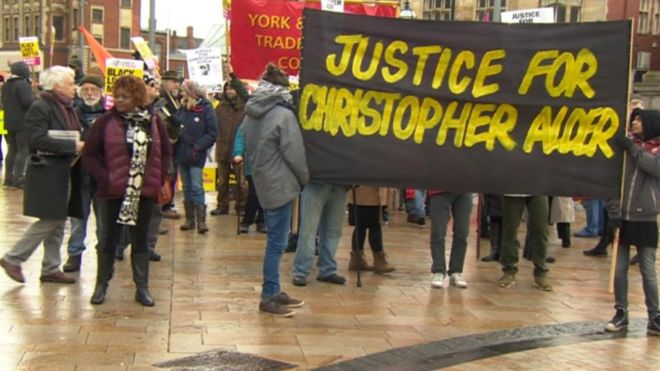
Hundreds gather for Christopher Alder memorial march

Posted by admin

On Saturday 31st March, the Christopher Alder Campaign for Justice and supporters held a memorial march to mark the 20th anniversary of Christopher’s death.

On 1st April 1998, Christopher died, handcuffed, lying face down on the floor of a Hull police station. As Christopher choked to death, police officers could be heard on CCTV laughing and making monkey noises. The disgusting police treatment of Christopher – and the subsequent treatment and harassment of his family – makes clear the racist impunity with which the police operate.

Saturday’s march brought around 200 people out on the streets of Hill to commemorate Christopher’s life, and to continue the fight for justice. Rousing and sobering speeches were following by a silent march around Hull and a deeply moving poetry reading. Following the march, a public meeting was held in a community space. The venue was filled with people who queued up to and out of the door.

Janet Alder at the commemoration event

The panellists and the audience all praised Christopher’s sister, Janet, for her tireless campaigning for justice. Discussions drew links between Christopher, David Oluwale, Stephen Lawrence, Joy Gardner, Rashan Charles, Darren Cumberbatch and countless others. The continuation of deaths (and particularly Black deaths) at the hands of the police, requires our ongoing attention. The police cannot continue to so easily disregard Black lives.

The Northern Police Monitoring Project stands in solidarity with Janet Alder, with the Christopher Alder Campaign for Justice, and with all who struggle against police abuses of power.