Archive for the ‘Uncategorized’ Category

NPMP Statement on the Police Killing of Chris Kaba

Posted by editor

We are truly heartbroken and outraged to hear the news of Chris Kaba’s killing at the hands of a Metropolitan Police firearms officer in London on Monday 5th August 2022 following a pursuit. 

Chris Kaba was a father-to-be and MOBO-nominated rapper. His death is an unjust and devastating loss. 

This case of an unarmed Black man being shot and killed – by a police force in special measures – is yet another example of the structural racism so deeply ingrained in British policing (and policing more broadly).This is a system that disproportionately criminalises, targets, arrests, convicts, imprisons and kills Black and racially minoritised people. It’s a system in which, since 1990, there have been 1833 deaths in police custody and/or following police contact. With Black and other racially minoritised people dying disproportionately as a result of the use of force by the police. 

Two months ago,after being Tasered on Chelsea Bridge in June,Oladedji Omishore, 41, fled and fell into the Thames whilst he was experiencing a mental health crisis. A 35 year old Black man was also killed in police custody in Truro, Cornwall. Stories continue to be released on the horrific incidents of strip-searches on children and weeks ago 10 young boys were sent to prison in Manchester on conspiracy charges through an investigation and trial which framed itself off the racist doctrine of Joint Enterprise.

Police violence will exist for as long as the police exist. In order to end police violence, we must continue organising to reduce the impact and need of the police, with the intention of abolishing them altogether. Our families and communities deserve to live in safety from state violence. 

At this stage, we warn people to be hesitant about misinformation which is rife in the aftermath of such tragic incidents, especially when spread by the state. 

We send our love, rage and solidarity to his family, partner and loved ones. We extend our solidarity and support to them and to all who are impacted by this racist injustice and racist policing practices everyday. Rest in power Chris Kaba.

Statement from the family and loved ones of Devonte Scott following Inquest

Posted by editor

At the end of the inquest, on 11th August 2022, Devonte’s family and loved ones say:

“Devonte was a well-mannered, polite young man. He was bright, considerate and had a way about him that as soon as people met him, they’d instantly like him. He was truly beautiful inside and out and we miss him more and more every day. 

Devonte died following a police pursuit on 16th May 2021. 

The inquest confirmed that there was no evidence to show that Devonte was involved in the theft of the vehicle.

We have concerns about the use of police pursuits by GMP and, in Devonte’s case specifically, we have questions about the use of self-authorisation – the process which allows a single officer to authorise their own pursuit. And there are also questions to be asked about the processes of risk assessment and communications with control. With other families who have lost loved ones, we are campaigning to address these questions and we hope that part of Devonte’s lasting legacy will be to prevent future unnecessary deaths as a result of police pursuit. 

We thank everyone who has supported us, the jury and the Coroner, Mr Chris Morris, for his investigation.”

On Manchester Caribbean Carnival entry refusals

Posted by editor

It is with rage that we hear roughly 50 young people in our communities have received letters from GMP’s Xcalibre Task Force, preventing them from attending this year’s Manchester Caribbean Carnival. The basis of these letters is GMP’s ‘belief’ that the individual who received the letter is either:

A ‘gang’ (something GMP have no definition for) is a deeply racist construct which finds young people – disproportionately black boys – labelled due to their friendships, interests or cultures. Evidence from groups and organisations such as Amnesty International UK have continued to show that the police, including GMP, label black boys ‘gang members’ with weak or non-existent evidence, conflate ‘gangs’ and youth violence, and build racist ‘gangs’ databases, all with an end goal of securing unjust prosecutions. Letters such as these are one of the many tactics at play in assigning the ‘gang’ label. 

The journey of carnival from being a community event to a corporate spectacle will continue to play a significant part in its policing becoming even more harmful. Our anger sits not only with GMP for this approach, but with the event organisers who are actively complicit, providing legitimacy for the policing of carnival. Furthermore, the letter states ‘you will not be permitted entry to the carnival as per the wishes of the organisers and the community’. We reject this, knowing many members of our community will not want these letters circulated in their name.

We ask if you or your loved one has received one of these letters, to make contact with us. We know young people and their families who have received these are in shock, and we send our love and care. 

We ask members of the community attending carnival to be aware of this issue, and look out for young people – particularly black boys – hoping to attend. The police will be preventing entry of those ‘perceived’ to be in a ‘street gang’, and we know full well that perceptions, and the ‘gang’ label itself, are racist. Reach out to anyone who is refused entry, document what you are told with their consent, and share the details with us via our reporting form, social media or email: npolicemonitor@gmail.com.

We want a safe Carnival too, and that includes safety from policing. As part of a wider anti-racist movement, NPMP remains committed to building effective non-policing solutions that keep us all safe. 

A threat to public safety: policing, racism, the pandemic and beyond

Posted by editor

Scarlet Harris

This article is from NPMP’s annual magazine. You can see the full magazine online, and order physical copies here.

How has the Covid-19 pandemic shaped experiences of police racism and racialised police violence, and what might new police powers mean for communities beyond the pandemic? 

As part of a collaboration between the Centre on the Dynamics of Ethnicity (CoDE) and the Institute of Race Relations (IRR), we published a report that explores experiences of policing amongst racially minoritised groups across England at this critical juncture. The report draws on in-depth conversations with 22 individuals who had interactions with the police during the pandemic, focusing on the testimonies of those subjected to policing. The findings from the research demonstrate that, rather than contributing to public safety, policing during the pandemic has reproduced profound harms for those from racially minoritised groups and communities.

Safety is a prominent theme throughout the report, but – in a challenge to dominant police narratives – it is the police themselves who appear as a major threat to the safety and wellbeing of research participants and their wider communities. For instance, a number of those who took part in the study recount how police officers they had interacted with over the course of the pandemic had failed to socially distance or wear adequate Personal Protective Equipment (PPE). In a particularly disturbing case, one woman described being stopped multiple times while heavily pregnant, and repeatedly having to ask police officers to socially distance and wear masks. We now know that unvaccinated pregnant women are amongst the most vulnerable to severe illness from Covid-19. 

But risk of Covid-19 transmission due to police negligence is just one of the ways in which the harms caused by over-policing have been exacerbated in the context of the pandemic. 

Policing was made central to the British government’s response to Covid-19, and police forces were granted extraordinary powers to enforce restrictions on movement and social gatherings, administer fines and detain potentially infectious people. This raft of legislation was rushed through parliament with minimal scrutiny, having severe consequences.

The racialised impact of these increased police powers has been well-documented. For example, Black and Asian people have been issued Covid-related fines at a rate 1.8 times higher than white people, while the initial months of the pandemic saw a marked increase in police use of force, and stop and search practices, which continue to disproportionately affect racially minoritised groups and communities.

Discussions with research participants reflected these patterns, revealing how new police powers have interacted with long-standing forms of racial and class inequalities to further criminalise those communities already subject to forms of violent over-policing. The report documents a number of experiences in which Covid-related powers were used to stop or even arrest individuals in conjunction with other highly racialised police practices, such as drug-related police stops. One individual described policing under Covid as: “Like a golden ticket to […] go out there in Black communities and just ridicule us.” The use of Covid-related regulations in the kidnap and murder of Sarah Everard by a serving police officer, which took place during the course of the research, was yet another heart-breaking reminder of how particular groups are rendered more (not less) vulnerable when police are granted exceptional powers.

Despite pleas from leading civil rights organisations to respond to the pandemic in a way that prioritised both public health and the upholding of civil rights, the government’s approach to policing reflected their ongoing commitment to an increasingly authoritarian agenda. Even as certain police measures are now scaled back while the pandemic develops, they have helped to pave the way for a massive expansion of policing in the coming years. The Police, Crime, Sentencing and Courts Bill (now Act) is set to increase a multitude of police powers, ensuring even less police accountability and hitting racially minoritised communities hardest, all while clamping down on our legal right to protest. 

The Covid-19 pandemic has revealed the extent to which we do and must depend on each other – for our health, well-being and ultimately our lives. Now is the time to connect various struggles around a common message: policing is not a public service, but another critical threat to our collective safety.

Questions for Abolitionists

Posted by editor

Siobhan O’Neill (NPMP)

This article is from NPMP’s annual magazine. You can see the full magazine online, and order physical copies here.

As someone who claims ‘I am an abolitionist’, I find myself asking questions about what this means and what questions come with taking up this position. While I am yet to have the answers – and perhaps need not have them all to imagine an alternative world – I share my ‘Questions for Abolitionists’ here in the hope that writing them down will help me think them through and perhaps be helpful for others too. I also hope that posing these questions might spark reflection and conversation amongst those of us interested in abolitionism. I frame these questions with police abolition specifically in mind – and in the context of the UK in particular – but it is important to note that police abolition is one part of a larger, global picture. Police abolition is linked, not only to prison abolition and the transformation of the criminal justice system, but also to the abolition of state violence in all its forms (for example border enforcement and migration controls) and, more broadly, of structures of global racial capitalism.  

Abolitionism, and police and prison abolitionism in particular, are not new. They have, however, become more widespread in popular discourse in recent times. Following the global Black Lives Matter mobilisations in 2020, which were ignited by widespread outrage at George Floyd’s death at the hands of police officer Derek Chauvin in the US and the continuity of police violence this case represented, conversations about defunding, divesting and abolishing the police have become ever more prevalent. While the violence and harms of policing are also not new, more and more people are recognising and critiquing how problematic policing and the cultures embedded in police forces are.

According to figures based on Home Office, IOPC and other governmental agency data, there were 1,804 reported deaths in police custody and/or following other forms of contact with the police between 1990 and 2021. Racially minoritised people die disproportionately as a result of use of force or restraint by the police and “in the past ten years, 8% of those who died in custody were racialised as Black, despite representing only 3% of the population”

Racially minoritised people are “disproportionately represented in the CJS at every level, from stop-and-search to arrests, conviction and imprisonment and deaths in custody”. It has also been reported that “there were 1,500 accusations of sexual misconduct (including sexual harassment, exploitation of crime victims and child abuse)” against police officers between 2012 and 2018.

Furthermore, “at least 15 women have been killed by police officers” and “one woman a week comes forward to report a serving police officer for domestic or sexual violence” with “700+ reports of domestic abuse” being made against police officers between April 2015-2018. Not only is it clear that “at every level, racism defines UK policing”, evidently, sexism too is a constituent part of UK policing (see Connelly, article five). As well as the statistical evidence, specific cases – such as the murder of Sarah Everard by Met Police Officer Wayne Couzens (and the excessive use of police force at the vigil held for her) as well as the (racialised) policing practices throughout the COVID-19 pandemic (see Harris, article two) – have demonstrated tangibly just how problematic the institution and cultures of policing are here in the UK (and beyond).

These are not problems that can be ‘reformed’ away, they are systemic and entrenched in the foundations of policing. From its emergence, policing has always been about ‘discipline and control’, ‘protecting private property, quelling social unrest, putting down strikes’ and disciplining the unruly poor rather than preventing crimes and protecting ‘the people’, as is commonly argued. Given these roots, refining and improving such an institution – one designed with these racialised, classed and gendered power dynamics embedded in it – is an extremely limited intervention. Rather than addressing the problems of policing through superficial reforms that make policing friendlier and more diverse, and seek to hold ‘bad apples’ accountable for their individual wrongdoings, abolition offers us a transformative solution to the problems of policing, by understanding those individual wrongdoings to be institutionally mediated. Thus, abolition is a process of dismantling the institution as a whole and the logics that underpin it, it pushes us to open up our political imaginations beyond the systems, structures and institutions that we take for granted. This, however, is not simple and there are a lot of challenging questions that arise through considerations of abolitionism, below I consider just a few.

What do we do in the meantime?

For abolitionists, building an alternative world is the goal. Yet building such a world is a challenge that takes time and a lot of work. The goal can feel a long way off so what do we do in the meantime? I begin with this question because it feels the most immediate.

In a context where policing is taken for granted and deeply embedded in our societies and cultures, what is best practice for abolitionists in the meantime? For instance, if I were to witness a man being violent and threatening towards a woman in public, and if that man were armed and I felt unequipped to intervene and that my safety might also be at risk, what should I do? Though I would feel conflicted about doing so, in such a situation and in a context in which policing seems to be the only option (or at least the most available option), I would be inclined to call the police, even as I acknowledge the inadequacy and risks of doing so. Similarly, if someone were to break into my flat late at night and I felt I was in immediate danger, what should I do? As a young woman of colour, the police don’t invoke a sense of safety and security for me. However, in a situation where there is immediate danger and no established alternatives to turn to, calling the police seems like an action I might have to take.  As abolitionists how can we reckon with this? What is the best course of action when there are not alternative and legitimate channels available? What is best practice for abolitionists in societies where we are yet to establish alternatives and in which we are striving for, but have not yet reached, abolition?

What are the alternatives to policing?

Following this, what are the alternatives to policing – and the current criminal justice system – and do we need to know what they are in order to be abolitionists? As Ruth Wilson Gilmore argues, “abolition is not absence, it is presence, it is “building the future”. As well as setting out to dismantle the institution of policing, we must adopt “proactive, visionary positions that centre alternatives to policing”. With this in mind, what are the processes, practices and institutions we would want to see in the quest to build alternative, better and more just societies?

Some of the alternatives should be structural solutions that tackle the issues at the root of ‘crime’. Investing in education and health services, building up and providing accessible mental health and counselling services, decriminalising and destigmatising drugs and sex work, as well as broadly tackling poverty would drastically transform our societies, opening up opportunities to those who have been disadvantaged and excluded from the formal economy. If people are denied access to or success in the formal economy, and if they are constrained to living in areas that have been neglected by the state, ‘crime’ can be the only option for survival. Dealing with the structural causes in this way would massively reduce ‘crime’ and thus the need for policing. This is especially pertinent given that, in policing and the popular imagination, the label of ‘crime’ is primarily reserved for the actions and behaviours of the poor and working classes.

As such, the police – and criminal justice system more broadly – tend to ‘excuse and ignore’ the crimes of elites while ‘intensely criminalising’ the poor and working classes. An example of this is the way that those whose actions led to the endangerment of tenants’ lives and actual deaths when Grenfell Tower caught fire in 2017 – the Kensington Tenants Management organisation, local and central government, and the companies that supplied the flammable cladding to Grenfell Tower – have not been held accountable.

As well as these systemic alternatives, are there alternative institutions we want in our abolitionist future? While abolitionists and those who have had bad experiences with the police take issue with the police’s self-appointed role as ‘protectors of the people’ who keep us safe, there is a question to be asked about what kinds of institutions and people we want to keep us safe, and when interpersonal violence does arise, what kinds of non-punitive and non-carceral processes might we have in place?

There is no singular or simple alternative to policing and the current criminal justice system. As Angela Davis says, we should look for “an array of alternatives that will require radical transformations of many aspects of our society”. What are some of the various options we might want? And relatedly, do we need to know exactly what our alternatives are to be abolitionists or is it enough to want to dismantle policing without having alternatives in mind?

What does justice look like after abolition?

Related to the idea of alternatives, there is a question to be asked about what justice looks like after abolition. What might we imagine justice to be when it is not punitive or carceral? In an abolitionist future, what does justice look like for those who have been subjected to violence and harm? What might a community-based system of justice look like and what steps must we take to implement such a system?

When thinking about these questions about abolitionist justice – particularly in terms of the way we approach the perpetrators of violence and injustice – I think especially about those police officers who have been responsible and/or involved in the unlawful killings of people like Sean Rigg, Christopher Alder, Joy Gardner, Leon Patterson, Sheku Bayoh, Ronaldo Johnson (see Pimblott, article six) and many others (see the United Families and Friends Campaign) who have died at the hands of the police. How can we hold these police officers – and others in the criminal justice system – to account? How do we seek justice while also being abolitionists who oppose the current structure and punitive ideology of the criminal justice system? How, as abolitionists, can we balance our goals with the immense grief and need to see those who have committed serious harms held accountable for their actions? In what ways can we give space to those who have lost loved ones and been so deeply harmed by violence and injustice that they might turn to carceral responses?

In an abolitionist future – which is one in which we no longer dehumanise those who have caused harm to others as the current criminal justice system does – what does justice look like when we recognise the humanity in those who we are holding accountable for their wrongdoing? How can we simultaneously hold people accountable and honour those who have been the victims of wrongdoing while recognising the humanity of perpetrators?

Does alternative language help or hinder abolitionist goals?

Following this idea of alternatives through, I wonder how using alternative language might help or hinder abolitionist goals? Often, the language of divestment and defunding comes alongside (or instead of) abolition. These terms may be useful as they might be less alienating to those for whom the idea of complete abolition is unimaginable, intimidating or too extreme. The idea of diverting money away from policing and channelling it into education, healthcare, poverty alleviation, youth centres and so on seems to be more compelling to a wider public and to those who are critical of policing but think that there might be a role for such an institution in our societies – even if that role is reduced or reformed.

In this way, it seems valuable that a wider range of people can be brought into conversations about the problems of policing, and perhaps these people might be likely to ‘get on board’ with abolition given that they are already have some shared ideas of defunding and divesting and looking for alternatives to practices of policing. However, I wonder how using alternative (more palatable) language might dilute some of the radical intentions behind abolitionism. With this in mind, as abolitionists, should we use alternative language and, when we do, what is best practice to ensure that it is effective and, simultaneously, allows us to retain the radical and transformative nature of abolitionism?

Can we abolish the police without abolishing the state?

If the police function, as many abolitionists argue, to protect and uphold the state as agents of state violence and control, should we shift our abolitionist focus from the institutions of the state to the state itself? If the state has shifted from the “(potential) provider of social goods to […] security machine pre-emptively weeding out threat”,

does it have a place in the abolitionist future? And in what ways might we organise our politics if we are to move away from this?

Returning to policing and the criminal justice system as the focus, is it possible to abolish the police (and prisons) without abolishing the state? Perhaps, but as Ida Danewid articulated when I asked her the same question, if we abolish the institution of the police without dismantling the state, its violence will likely be carried out by another institution and/or in different forms. In which case, abolishing the state seems necessary. A secondary question that emerges from this is, should (or can) our solutions include the government? Given that the government can be understood as the particular group of people who govern the state and who have control over state apparatuses, is a solution that includes the government necessarily limited in that it does not extend to the state? While the concept of government is different from that of the state – the state is a political organisation that has jurisdiction over a particular territory and the government is one part of that organisation – the two are inseparable. I’m thinking about Alex Vitale’s ‘The End of Policing’ here, in which he argues “we need to build the capacity of communities to solve problems on their own or in true partnership with government”, and “we can use the power of communities and government to make our cities safer without relying on police, courts, and prisons”. Vitale imagines the government to be a “non-punitive” one, but does the inclusion of a government, no matter how non-punitive, necessarily limit abolitionist goals because of its inseparability from the state?  

For those abolitionists who are in favour of abolishing the state, there is another question about where our focus should lie. If we decide that it is in fact necessary to abolish the state, should we work from the bottom-up (abolishing various institutions in order to abolish the state) or from the top-down (abolish the state and the rest will follow)? Maybe it’s both or somewhere in between. There does not seem to be a clear answer. Referring back to the first question I posed – concerning ‘what we do in the meantime’ – might be useful here too. If state abolition is an unimaginable, far-off and contentious goal, to what extent can and should we include non-punitive governments in our steps towards abolishing the police while we are striving toward a broader, more radical abolition? Can we work with the state and/or governments in the meantime?

Concluding Remarks

These are big questions, to which I don’t have the answers, however, it is clear that we should continually engage with and grapple with these (and more) questions as we work toward abolitionist goals. There are no singular or simple answers to these questions, but it is important that we think about them collectively, not only for ourselves, but also that we might be better placed to respond to those who oppose abolition or who are yet to be convinced that we can imagine other societies.

Statement from Family of Brandon Geasley following inquest

Posted by editor

At the end of the inquest, on 8 July 2022, Brandon’s family say:

“Brandon was a loving son and brother. We miss him so much.

We believe Brandon was killed as a result of the unnecessary and disproportionate police pursuit. It cannot be right that the police pursue at over 120 mph, for minor allegations, with such a significant risk to life and safety.

GMP showed a complete disregard for the life of Brandon and the public.

We are pleased the evidence in the inquest demonstrated that he did NOT steal the vehicle that he was driving. It also showed that he had ADHD, which would have impaired his decision making.

So many young boys are being killed in this way and enough is enough. We are working with other affected families and we are planning to a launch a major campaign alongside other bereaved families.

The experience of losing Brandon has been devastating. We wish our experience never to be repeated. We wish to create a legacy in the memory of Brandon. We will continue to pursue justice for him and other loved ones and we thank everyone for the enormous support we have received throughout. 

We give our thanks to the Coroner, Adrian Farrow, for his sensitive and detailed investigation.

We also extend our condolences to the family of Mr Faulkner. If they ever felt ready to speak to us, we would always be open to doing so.”

Statement on the Unjust and Racist Prosecution of 10 Boys in Manchester

Posted by editor

We write in outrage at the unjust, racist and classist prosecution of 10 boys from our city found guilty by association for the crimes of conspiracy to commit murder and conspiracy to commit GBH. No one was killed in this case and, nearly forty days in court revealed, many of those prosecuted were never involved in or accused of direct involvement in any violence. Rather the prosecution deployed a racist ‘gang’ narrative drawing upon text messages, drill lyrics and videos to bind and implicate all ten in a criminal conspiracy. We recognise that the few who committed harm admitted this and accepted responsibility for hurting others. Others who committed no harm were implicated simply for sending text messages in grief following the death of a childhood friend. These boys needed support and care in dealing with their grief. All are now facing lengthy prison sentences, their lives and freedom – the years of their 20s and 30s – stripped from them. Their families and friends are facing the devastating loss of their kin and loved ones.

We stand in solidarity with the 10 boys, their families, friends and loved ones and all those found guilty by association. 

We condemn the State’s punitive response to the grief of our young people and the lack of societal care for those who needed support. The testimony given by these boys should educate us all in the interlocking structures of state violence responsible for the real conspiracy to strip young Black and working-class people of their freedom. Those structures can be tracked from draconian school exclusion policies and racist policing practices to the £2.5 million super court in which this, and many other ‘gang’ prosecutions, will be held. 

We thank Kids of Colour and their director Roxy, one of our steering group members, for supporting the boys and for telling us all about who they really are. We are grateful for your tireless reporting, keeping us all informed and challenging the racist ‘gang’ narrative painted by the prosecution and media. 

This is not the first and it will not be the last case of collective punishment. We stand with Kids of Colour and JENGbA in calling for the abolition of the Joint Enterprise doctrine and ‘guilt by association’ in all its forms and we back the call for the creation of healing-centered alternatives that create safety in our communities not punishment. 

CALL TO ACTION

Join us at the daytime demo in solidarity with the boys and all those found guilty by association on Saturday 28th May 2022 at 1pm, St. Peter’s Sq. 

Come to the sentencing on Thursday 30th June at 11am, Manchester Crown Court. 

Follow and support Kids of Colour and JENGbA for more information and actions you can take. 

Letter of concern regarding police pursuits in Greater Manchester

Posted by editor

Manchester Stands in Solidarity with Child Q and Calls for ‘No Police in Schools’

Posted by editor

Kerry Pimblott, Northern Police Monitoring Project (NPMP)

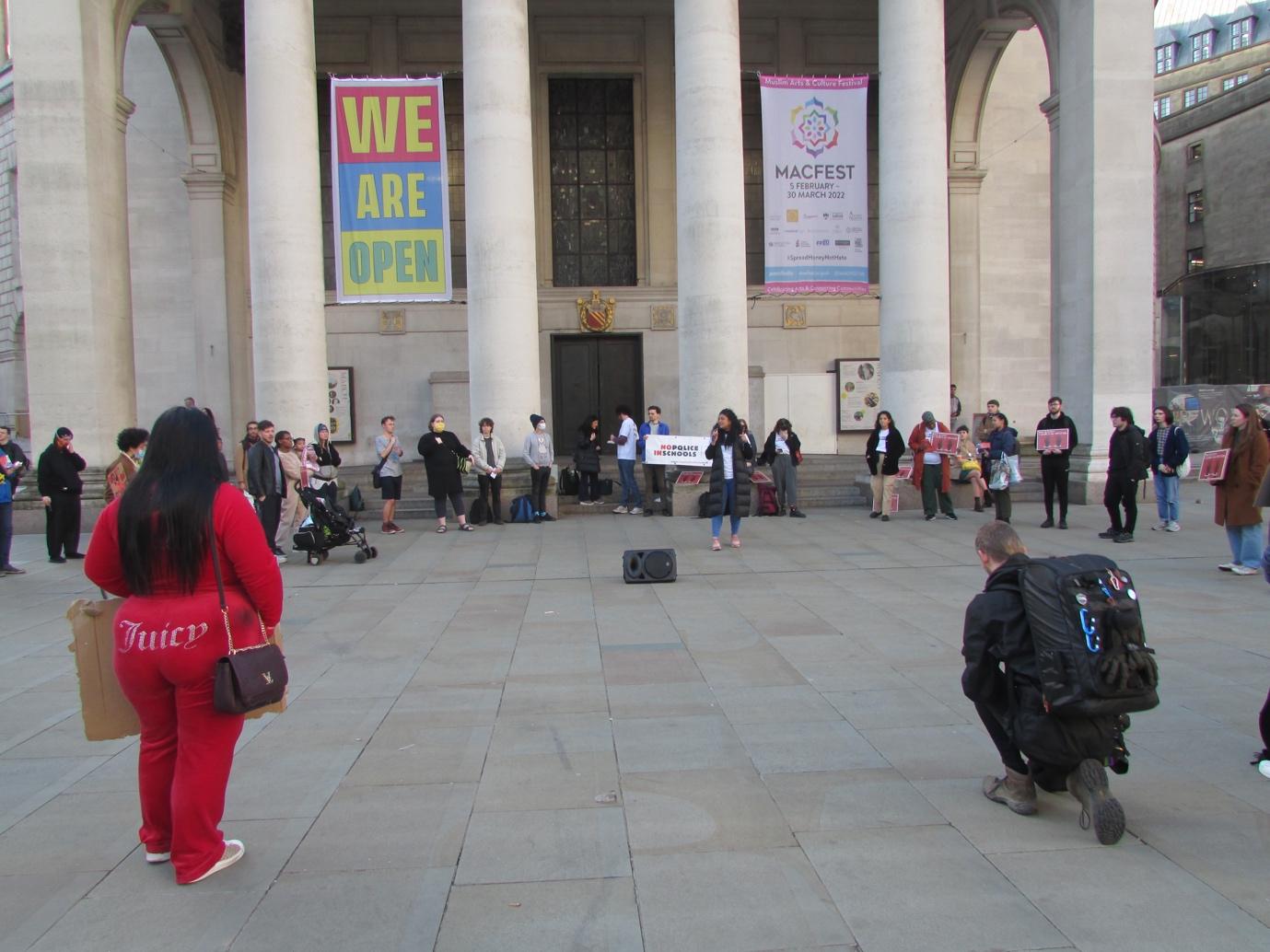
Hundreds gathered in St. Peter’s Square in Manchester on Friday to express solidarity and outrage at the treatment of ‘Child Q’, a 15-year of Black girl subjected to a strip-search by Metropolitan police officers at her school without the presence of an appropriate adult or parental consent. Organised by a coalition of local groups – including the Northern Police Monitoring Project (NPMP), Kids of Colour, No More Exclusions, Sisters Uncut, Kill the Bill MCR, and MCR Copwatch – the demonstration renewed calls for the removal of police from schools and the realisation of abolition in our lifetimes.  

A picture containing building, outdoor, sidewalk, people

Description automatically generatedNPMP’s Zara Manoehoetoe addresses the crowd in St. Peter’s Square
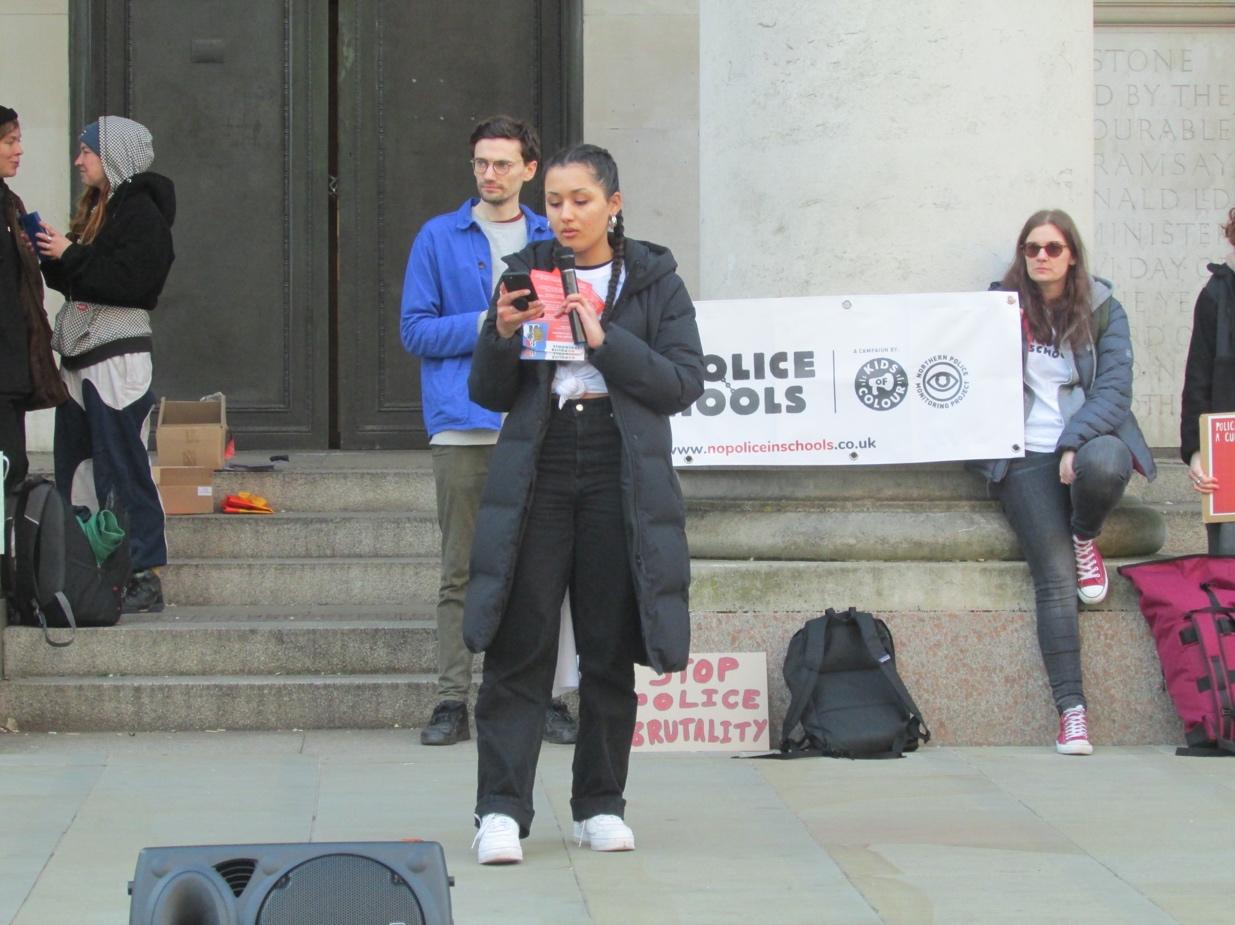
In Manchester these demands are far from new. Following a series of complaints raised by young people in 2019, NPMP and Kids of Colour submitted a Freedom of Information request that revealed that Greater Manchester Police (GMP) planned to put twenty additional police in schools for the 2020/21 academic year. As the nation went into lockdown following the outbreak of Covid-19, grassroots organisers held forums, crafted an open letter to Mayor Andy Burnham, and launched an online survey to consult young people, parents, teachers, and wider communities about their views on the decision. The results of the survey provided the foundation for a subsequent report, Decriminalise the Classroom: A Community Response to Police in Greater Manchester’s Schools (2020), which, as NPMP member Siobhan O’Neill explained, revealed widespread opposition to police in schools and concerns that their presence exacerbates existing inequalities, foster a culture of low expectations and create a climate of hostility that leads to the criminalisation of young people, particularly working-class and racially minoritised students. Instead, respondents overwhelmingly called for funding to be spent on non-punitive alternatives such as youth workers, counsellors, and more teachers. 

A person holding a sign

Description automatically generated with low confidenceNPMP’s Siobhan O’Neill describes the findings of the 2020 Decriminalise the Classroom report
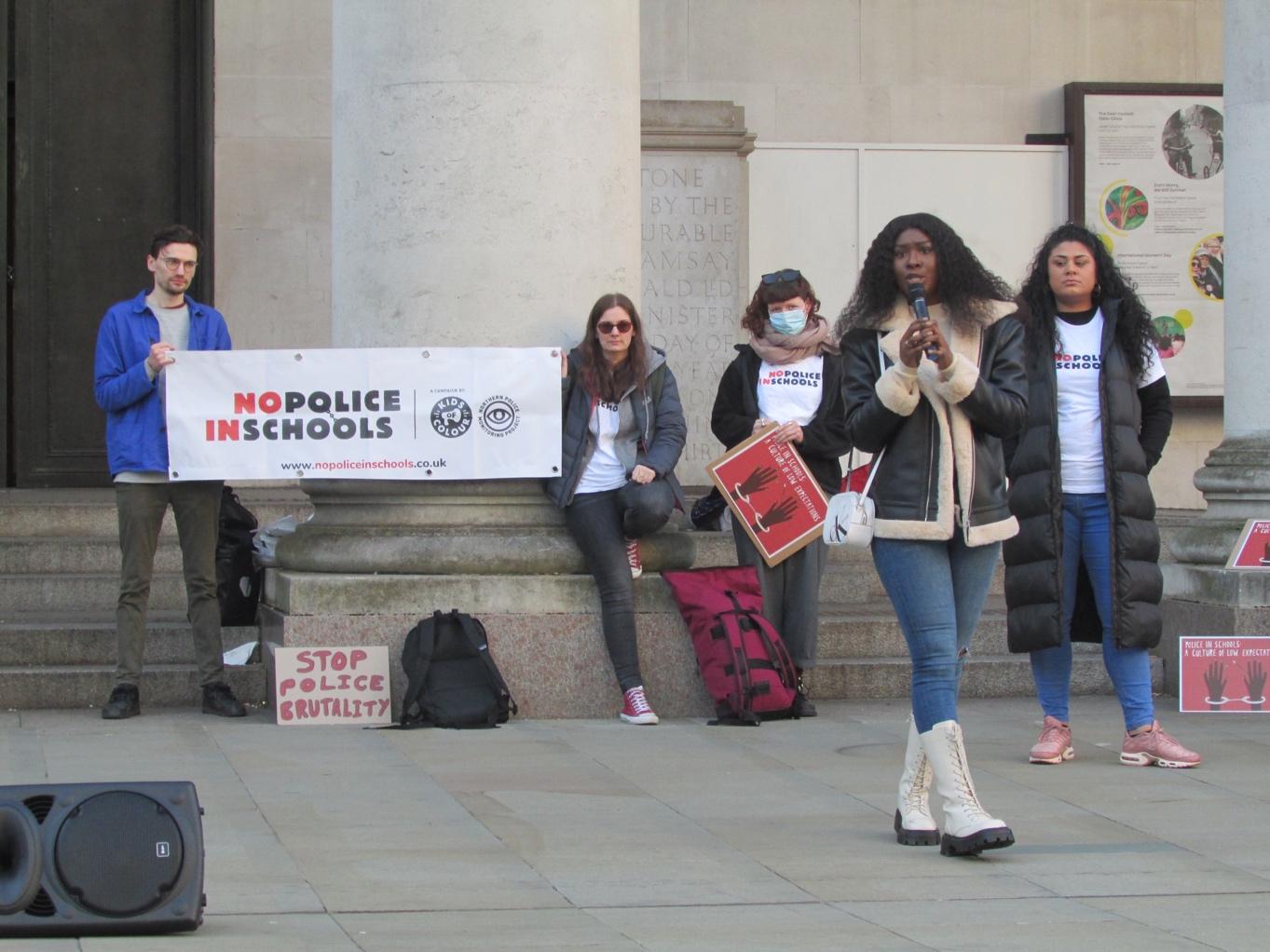
During Friday’s demonstration, these concerns were echoed once again by parents, campaigners, and young people outraged by the account of sexuall abuse and trauma experienced by Child Q. Among the speakers was Lisa Eigbadon: ‘I felt compelled to speak today because No Police in Schools is a movement and campaign I’m very passionate about because I went to a school with a school based police officer,’ Eigbadon explained. ‘When I heard about Child Q I felt sick in my stomach, and I put myself in her position and her shoes because I’ve been subject to police confrontation […] in school’. 

A picture containing person

Description automatically generatedLisa Eigbadon describes attending a school with a school-based police officer in Manchester
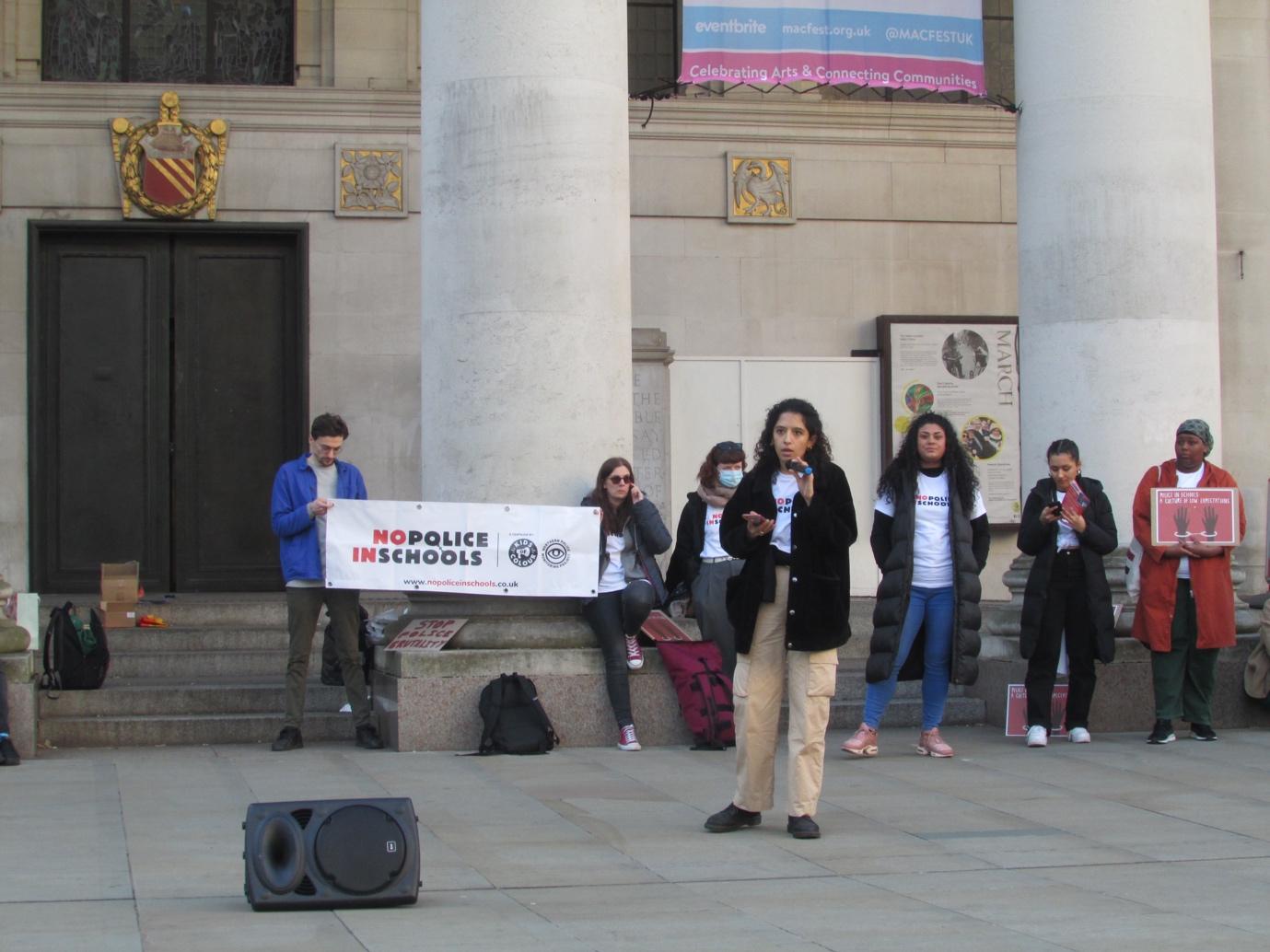
Angela Henry of the Manchester branch of No More Exclusions and Eline Davies of Kill the Bill Manchester connected Child Q’s experience to wider systemic patterns of racialised surveillance, discrimination and violence in schools. As Angela Henry explained, ‘Child Q is not the first Black young person that finds themselves being dealt with disproportionately, aggressively, illegally and traumatically at the hand of police who are supposed to serve and protect, and she won’t be the last under current policing structures.’ All of the speakers insisted that ‘police have no place in schools’ and joined Henry in calling for non-punitive transformative justice interventions of the type outlined in the recent No More Exclusions report, ‘“What about the Other 29?”: Demystifying Abolition in the UK Education System’. ‘Abolition’, as NPMP member Zara Manoehoetoe explained, ‘is about putting love and care at the centre of our approach.’ 

A group of people standing on steps holding a sign

Description automatically generated with low confidenceKids of Colour founder, Roxy Legane, addresses the crowd in Manchester.

Kids of Colour founder, Roxy Legane, recounted some of the more recent developments in the local No Police in Schools campaign which through collaboration with young people, parents, and members of the National Education Union’s North West Black Members Organising Forum secured a landmark victory in July 2021 when Councillor Garry Bridges  announced that plans to introduce twenty additional officers were being scrapped. Despite these gains, Legane cautioned that police are still a presence in many local schools and that parents at a school in Trafford are currently embroiled in a battle to halt the introduction of additional officers. As Legane explained, such developments contradict the stated policy of the Greater Manchester Combined Authority that if a school does not want an officer, they will not be forced to have one, a reality that necessitates concerned parents, young people, and community members continue to push back. Pushing back, Manoehoetoe asserted, means identifying those schools that have, or are seeking to introduce, a police presence and contacting the board of governors and local councillors to express your discontent. Whether they are operating as ‘schools-based police officers’, ‘school resource officers’, ‘school liaison officers’ or by another name, if you are a teacher you should organise with your local union to pass motions opposing police in schools. And, you should join the more than 25,000 people that have already signed the No police in UK schools petition.

Withdraw your consent.

Abolition in our lifetimes. 

Statement regarding police precept tax increase

Posted by editor

On Monday 31st January, the Greater Manchester Police, Fire and Crime Panel voted unanimously to approve an increase in Council Tax to fund more police. 

Given that the Greater Manchester Combined Authority’s (GMCA) own consultation found only 23% of respondents to be in favour of the tax increase, the decision shows just how little regard GMCA have for the public of Greater Manchester, and particularly those who are subject to the harms of policing. 

The Council Tax increase will further exacerbate a cost-of-living crisis which is having a devastating impact across the city region, particularly for working class communities. It also comes amidst a raft of evidence of institutional racism in the force, at a time when GMP has been placed in special measures for systemic failings. 

In making his case for the increase, Mayor Burnham made a range of claims without evidence, only addressing the consultation when challenged by a member of the public. In so doing, he showed clearly just how undemocratic his decision-making is. 

As the live stream of the Panel meeting was stopped, members of the public were removed from the supposedly-public meeting, and others – including a member of the Greater Manchester Race Equality Panel – were denied entry. This led members of the public to ask, ‘is this what democracy looks like?’

It is clear that those in power in Greater Manchester feel able to make decisions, far removed from members of the public, in comfortable boardrooms without public scrutiny or challenge. However, as Kill the Bill, Black Lives Matter, and other mobilisations of the last few years have shown, affected communities are increasingly demanding non-police responses centred on care. As part of a wider coalition of resistance, NPMP will continue to advocate for such alternatives.